What is USVC's largest holding? It isn't Anthropic or SpaceX.
As of September 30, Supabase was USVC's largest holding at 10.9% of the fund's net assets, just ahead of Mercury at 10.7%.
But a lot has happened since we announced our investment in Supabase back in June.

October was big for Supabase
On October 2, Supabase announced three things.
$150 million in new funding. GIC led the round, with CapitalG (Alphabet's growth fund), IronArc, and SquarePeg participating. It came four months after a $500 million Series F at a $10 billion pre-money valuation, and part of it lets employees sell shares without waiting for an IPO.
A deal to acquire Turso. Turso rebuilt SQLite, a small, lightweight database, so that a single server can run millions of them, waking each one only when it's needed.

Supabase Compute. A new product, now in private alpha, that runs agents and web services right next to the database.
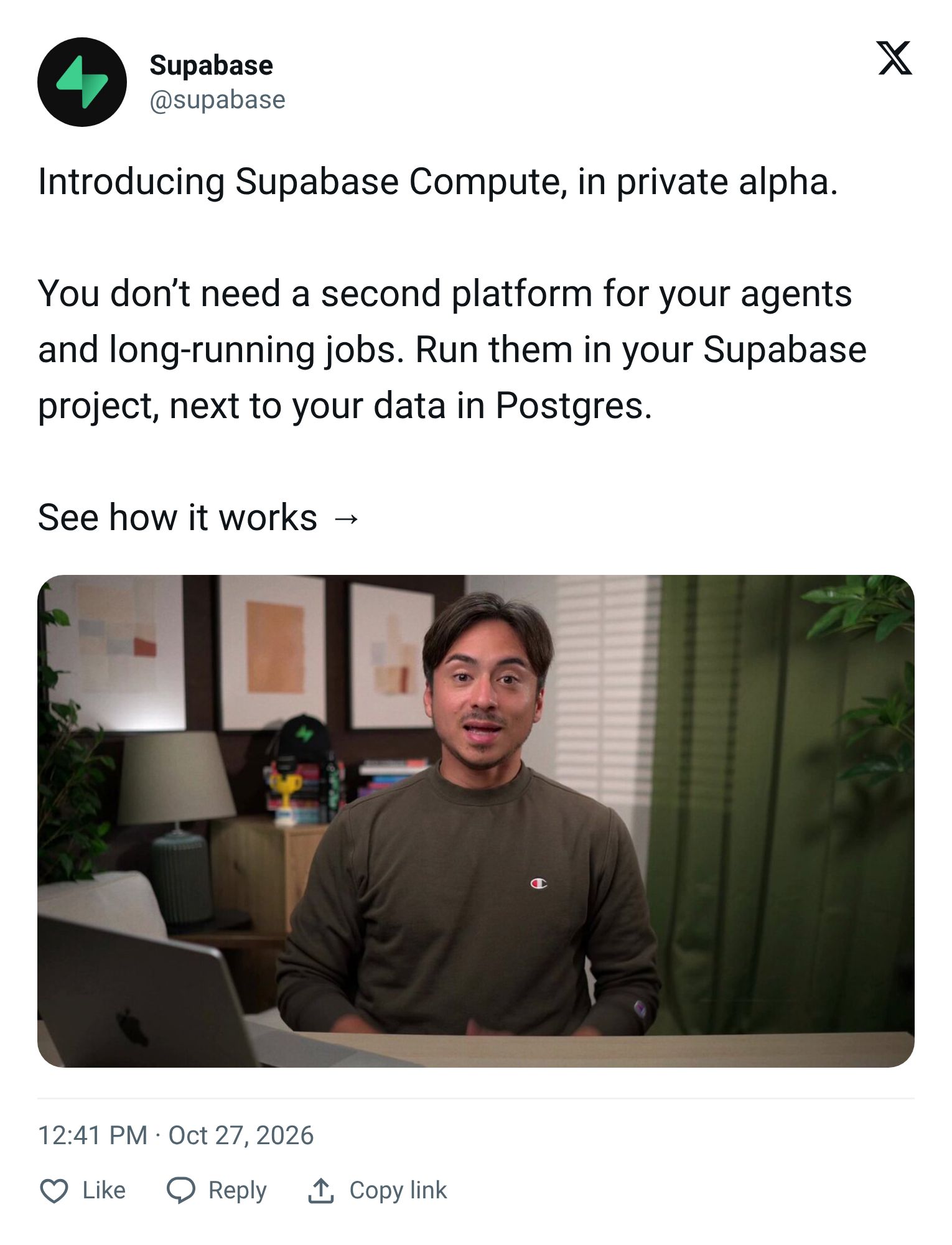
All three things point at the same customer: the AI agent.
Agents create databases constantly, many of them small and temporary, while they prototype and test. Turso is built for that load. Copplestone wrote that "agents should be able to create a database as easily as creating a file." Turso's founder has said his goal is to serve "upwards of a billion databases."
Compute moves Supabase from storing an agent's data to running the agent itself. If it works, Supabase gets a larger share of every app built on it.
Agents don't shop around
When a developer picks a database, they compare options and often stick with what they've used before. An agent asked to build an app makes that choice in seconds, and it tends to reach for whatever is already set up as the default.
That changes how a company like Supabase grows.
In June, Copplestone said agents were deploying "the majority of databases" on Supabase. By October, Supabase put the share of new databases created by agents or AI tools at 70%, with more than 4 million new databases a month.
Over the same stretch, its developer count went from more than 9 million to more than 13 million.

Lovable shows how one default decision compounds.
In late 2024, its team of ten people needed a backend for every app its users described. Rather than build one, they integrated Supabase in January 2025.
Now, when someone describes an app to Lovable, Lovable can set up the tables, storage, logins, and security rules on Supabase through a single API. Lovable says it sees about a million new projects a week, and many of them run on Supabase.

The same thing happens through the AI labs' own tools. As of June, Claude Code was the largest contributor to Supabase's growth this year, and Supabase also runs as an official app inside ChatGPT.
That's part of why we like the position. Supabase can grow with agent-built software whichever model ends up on top, similar to how we described Baseten in our Q3 update.
Three things we're watching
For most of software's history, developer tools won by winning over developers: docs, conferences, word of mouth, and whatever people learned at their first job.
If agents do more of the choosing, that playbook changes. The tools that win may be the ones agents reach for by default, built into products before a person ever sees a sign-up page.
We think that could change which infrastructure companies get big, and how fast. Supabase is an early test, and three things will tell us whether the idea holds:
Whether Supabase stays the default. Much of its growth now arrives through other companies' tools. Claude Code has been the largest contributor, and Lovable offers Supabase under its own name, Lovable Cloud. Those partners help Supabase grow, and they also decide what the default is.
Whether agent-built apps stick. Millions of new databases a month only matter if they turn into apps people keep using and paying for. Over time, we think that will say more about Supabase than the database count.
Whether guardrails hold up. Agents tend to take the easiest path, which helped make Supabase the default. It can also work against it.
In September, security firm UpGuard found about 16,000 Supabase-hosted databases with personal data open to the web.
On October 30, Supabase stopped exposing new tables to its public APIs by default. But, as some have warned, when an AI coding tool hits the new permission error, it may fix it by opening every table back up.
We don't yet know how guardrails will hold up when agents do most of the building, at Supabase or anywhere else.
None of this is guaranteed, and private companies carry real risk. But we think the companies agents build on could end up mattering as much as the models doing the building, and we believe Supabase is one of them.
How we own it
USVC gained exposure to Supabase by buying into a seed-stage fund that held Supabase shares. That manager found Supabase early, well before a $10 billion valuation was on the table, and we acquired our position below Supabase's most primary round price at the time.
This is the multi-manager side of how USVC works. We back the investors who find great companies first, and sometimes the best way into a company is to buy a position from an existing fund at terms the primary round no longer offers.
To be precise: you don't hold Supabase shares, and you don't hold the underlying fund. You own shares of USVC, a registered fund that holds this position alongside companies like Mercury and Ramp.
Getting in
USVC is a registered fund that helps broaden access to venture capital. Invest from $500, any business day, at NAV. No accreditation required.
If you already own USVC, you already have exposure to Supabase, alongside Mercury, Ramp, Anthropic, and more.
— Ankur
USVC invests in portfolio companies directly, through private funds, and special purpose vehicles. For important information and USVC holdings, please see https://usvc.com/portfolio.
P.S. USVC is now available on Alinea!
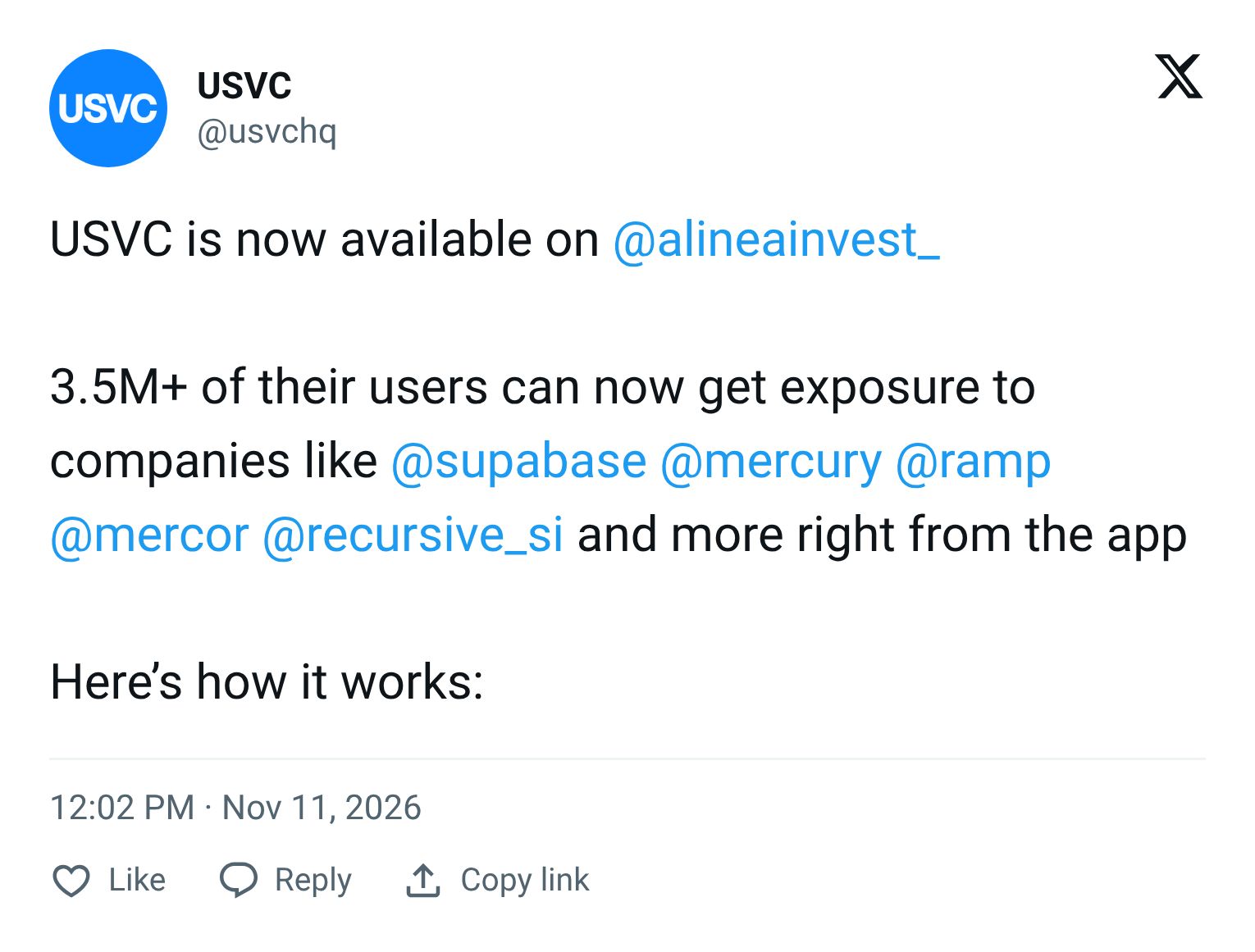
Alinea is the agentic investing companion for the next generation, with 3.5 million downloads, 350K+ active traders, and $1.4 billion in trading volume this year.
With portfolios built around your goals and education woven into the app, Alinea helps you understand what you own and why.
We believe that approach matters especially in venture, where understanding the risks and investing with a long time horizon are essential.
Access to private markets has traditionally come later in an investor’s journey. Through USVC on Alinea, investors can now explore the asset class earlier alongside education to help them decide whether it fits their goals.
P.P.S. In portfolio news, Mercor just announced a $750 million Series D at a $20 billion valuation from Benchmark, General Catalyst, NVIDIA, Salesforce, and Zoom.
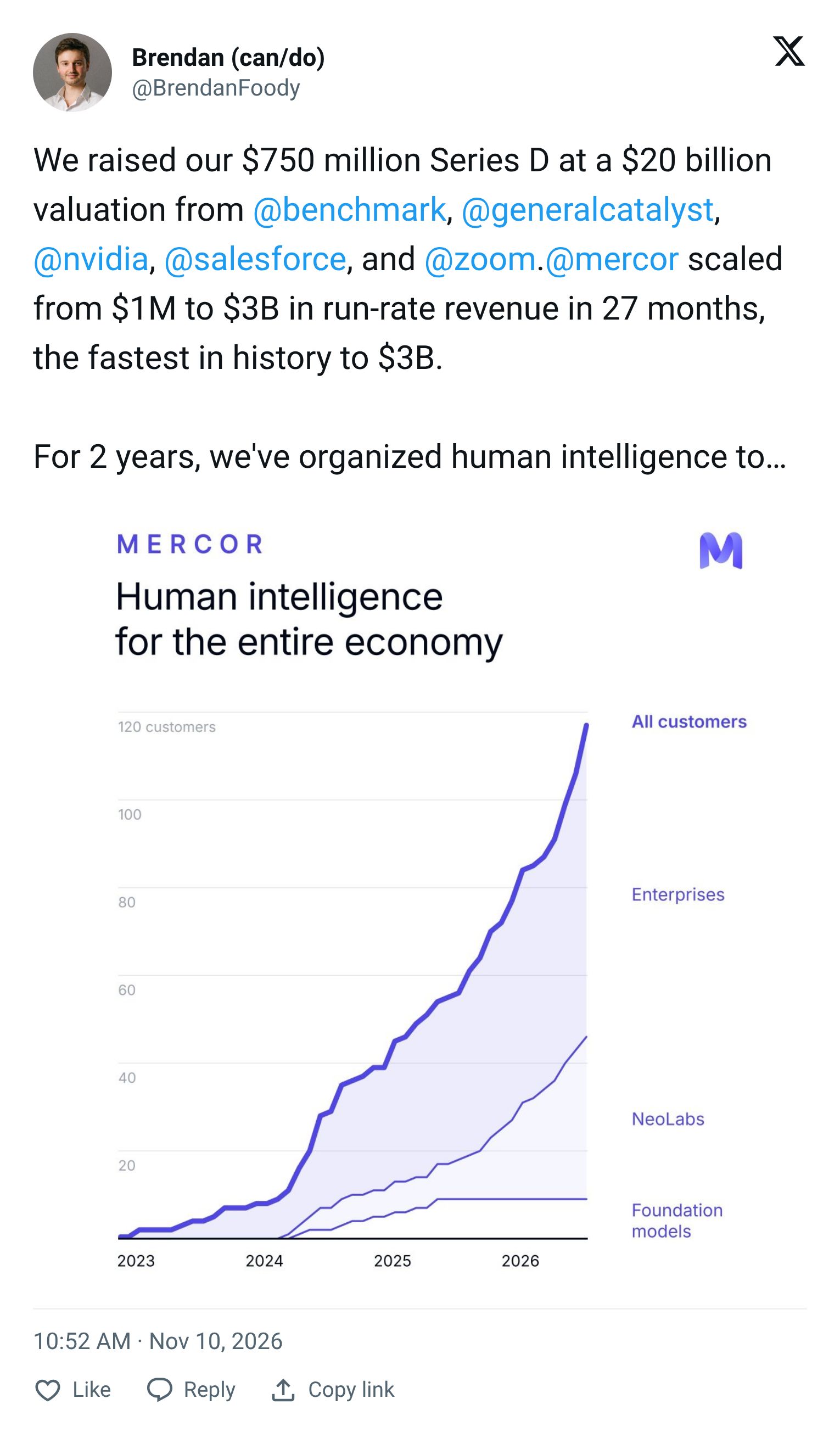
For most of its life, Mercor has served a small group of customers: the frontier AI labs. It brings in experts to build the evals and training data their models learn from.
When we announced our investment, we were betting that Mercor could serve a much wider market. We believe large companies will want to train and tune models on their own expertise, and they'll need the same help the labs get today. Mercor says that shift has started. Its growth has picked up over the past six months as enterprises begin evaluating and training their own models.
Like Supabase, Mercor is part of what the models are built on, not a bet on which model wins. As of September 30, it was 3.5% of USVC's net assets.
Investors should carefully consider the investment objectives, risks, sales charges and expenses of USVC before investing. USVC's prospectus contains this and other information and may be obtained at http://usvc.com/prospectus or by calling +1 (888) 200-4361. Read the prospectus carefully before investing.
This communication is for informational purposes only, is not intended to be a recommendation for any investment or other advice of any kind and shall not constitute or imply any offer to purchase, sell or hold any security or to enter into or engage in any type of transaction. Any such offers will only be made pursuant to USVC's prospectus, which should be carefully reviewed before investing.
Investing in the USVC Venture Capital Access Fund involves significant risk, including the possible loss of principal. Venture capital investments are speculative, illiquid, and subject to a high degree of risk. Past performance does not guarantee future results.
USVC Venture Capital Access Fund is distributed by North Capital Private Securities Corporation (NCPS), member FINRA/SIPC. NCPS is not affiliated with USVC's adviser or its affiliates.
Investing in USVC's shares involves substantial risk, including the potential loss of your entire investment. Shares are not listed on any exchange, are illiquid, and liquidity is limited to periodic repurchases at the discretion of the Board, which are not guaranteed. This investment is speculative and suitable only for long-term investors who can bear the risks of limited liquidity. Certain conflicts of interest involving USVC and its affiliates could impact USVC's investment returns and limit the flexibility of its investment policies. Past performance does not guarantee future results. Fees, expenses, and conflicts of interest may reduce returns.
USVC's shares have no history of public trading. You should not expect to be able to sell your shares other than through USVC's repurchase policy, regardless of how USVC performs. USVC does not intend to list its shares on any securities exchange during the continuous offering, and it does not expect a secondary market in the shares to develop.
USVC invests in portfolio companies directly, through private funds and special purpose vehicles, which are subject to certain risks including those related to illiquidity, indirect fees, valuation, limited operating histories and limited information regarding underlying investments. As a result of the foregoing, an investment in USVC's shares is not suitable for investors that require liquidity, other than liquidity provided through USVC's repurchase policy. The amount of distributions that USVC may pay, if any, is uncertain.


